How to Trade a Recession Scare: A Practical Playbook for 2026

Recession odds are at 42%. The S&P 500 is down 1% today. Oil is above $108. The Fed is stuck. This is a recession scare, not a confirmed recession, and that distinction changes everything about how you should be positioned right now.
What a Recession Scare Looks Like
A scare is when the data gets bad enough to move prediction markets but not bad enough to confirm a contraction. We are there. Polymarket’s recession contract sits at 42%, Goldman Sachs has raised their probability to 35%, and the jobs market missed estimates by 62,000 in February. But GDP is still positive, consumer spending has not collapsed, and no major bank has flipped their base case to recession yet.
Historically, scares resolve in one of two ways. Either the trigger fades (oil comes down, the geopolitical risk clears, the data stabilizes) and equities rally hard from oversold levels. Or the data keeps deteriorating and a real recession follows. The ratio of false alarms to confirmed recessions over the last 30 years is roughly 3 to 1. You do not want to be fully out of the market if this is one of the three false alarms.
What Not to Do
Do not panic-sell equities. The SPY is down about 3% from its recent high. That is not a crash, that is a repricing of risk. If you sell now, you are selling after the scare is already in the price. The time to reduce equity exposure was when recession odds were 20%, not 42%.
Do not chase oil. USO is up over 2% in a single session and crude is above $108. The geopolitical premium from the Hormuz situation is real, but it is already priced. Chasing a commodity that has already moved 15% is a different trade from the one that made sense three weeks ago.
Do not go all-in on gold. Gold is flat to slightly negative this week. It is not functioning as a safe haven in this environment because the fear is energy-specific, not broad macro panic. Adding gold at current levels is not the hedge it appears to be.
The Playbook
- 1.Rotate toward defensive sectors. Utilities, consumer staples, and healthcare consistently outperform in slowdowns. They are not exciting but they hold up when cyclicals get hit. The Dow at -1% today is being dragged by industrials and financials, not defensives.
- 2.Build a 10 to 15% cash buffer. Not because you are going to cash. Because optionality is valuable when the data is ambiguous. If the CPI print this week is hot, markets will sell off further and you will have dry powder to buy at better prices.
- 3.Keep crypto small but do not exit. BTC at $70,320 is holding up. It is one of the few assets not pricing in a recession. A small allocation (under 5% of portfolio) is reasonable. If BTC breaks below $65,000, that is your signal that risk appetite has turned fully defensive and you should reduce.
- 4.Watch the Fed, not the politicians. Rate cut pressure is loud right now. But Powell moves on data, not on noise. The only thing that changes the Fed’s calculus is a CPI miss combined with rising unemployment. Until both are true, the Fed is on hold and rate-sensitive trades stay risky.
What to Watch as Your Signal
Three data points will tell you whether this scare is resolving or escalating:
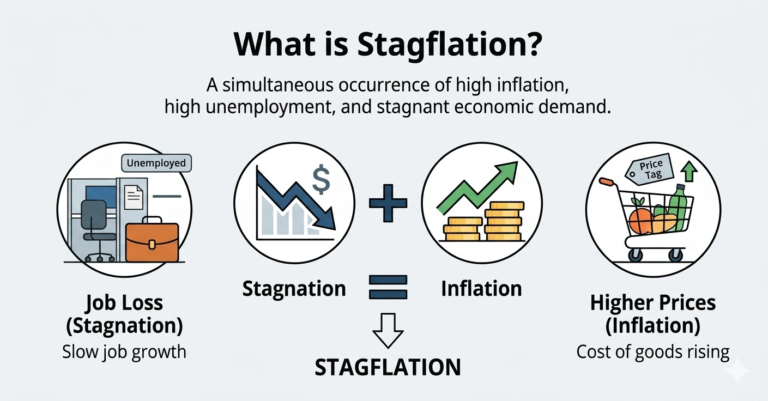
- →CPI this week. Energy has already added roughly 0.4 percentage points to headline inflation. A hot print above 3.5% signals stagflation and locks the Fed in place. A soft print gives the Fed room to act and changes the calculus fast.
- →Goldman or JPM flipping their base case. When bulge bracket banks move from “elevated risk” to “base case recession,” institutional flows shift within days. That is the institutional tell that changes positioning across asset classes.
- →BTC below $65,000. Crypto is forward-looking and liquid. If Bitcoin breaks that level on high volume, it signals that risk appetite has flipped in a way that equity indexes have not yet fully reflected.
The Bottom Line
The 42% recession probability is already in the price of equities. What is not priced is confirmation. Position for elevated risk, not for a confirmed downturn. Reduce exposure to cyclicals, keep some dry powder, and do not make any all-or-nothing bets until the data resolves one way or the other. The traders who survive scares are the ones who stay disciplined enough to act on signals rather than sentiment.